Why Your Business Needs a WIG

If you run a nonprofit or small business, you are familiar with the whirlwind. It's the seemingly never-ending emails, the fires to put out, the "quick calls" that eat your whole afternoon, last minute items being added to your to-do list (that somehow never gets shorter).
Let’s be so for real, the whirlwind likely isn't going anywhere. It's just part of the job. That said, if you're only ever reacting to the whirlwind, you're not actually moving your mission forward. You're just staying afloat.
That's where the idea of a WIG comes in.
What's a WIG?

Unfortunately, we don’t mean a fake head of hair (if only that could fix everything). No, WIG stands for Wildly Important Goal, a concept from the book The 4 Disciplines of Execution. The premise is simple but kind of a gut check: most organizations try to focus on too many goals at once, and when everything is a priority, nothing really is (a song we bet you know well).
A WIG asks you to pick one goal (maybe two, tops) that matters more than anything else right now, hence the wildly important title. This goal needs to be something specific enough that you'll know exactly when you've hit it (more on that later).
Why Just One?

This is the part that trips people up the most. It feels wrong to narrow your focus when there's so much to do. But that's exactly the point. The whirlwind will always compete for your attention, so your WIG has to be protected on purpose. Give a team five goals, and they'll quietly deprioritize all of them. Give them one clear, wildly important goal, and you’ll notice something interesting - they actually start moving toward it.
Write It Like A Finish Line
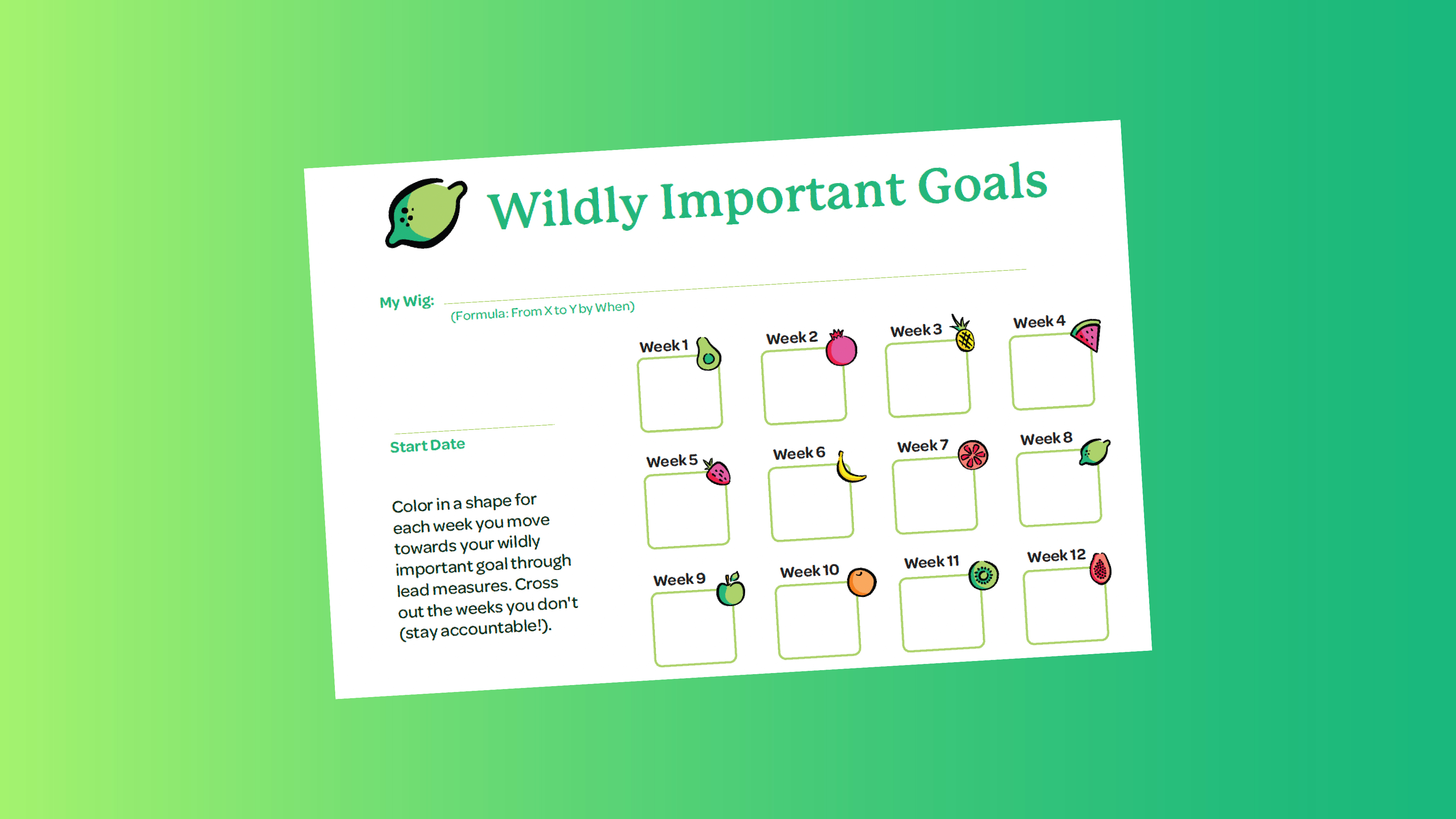
A WIG only works if it's specific enough to actually finish. The format 4DX recommends is simple: From X to Y by When.
❌"Increase monthly donations"
✅Increase donors from 200 monthly donors to 350 monthly donors by December 31.
❌Grow our email list
✅Grow our email list from 800 subscribers to 1,500 by end of Q3
That "by when" matters just as much as the number. A goal without a deadline is just a nice idea. A goal with one is a finish line your whole team can actually run toward.
Keeping Score, Out Loud

Here's the other piece that makes WIGs stick: a visible scoreboard. Not a spreadsheet buried in someone's drive. Something your team can glance at and instantly know if you're winning or losing.
The trick to keeping score well is understanding the difference between lead measures and lag measures, and tracking them at different speeds.
Lag measures tell you the final result. They're what you're ultimately trying to change, but you usually can't influence them directly, and you only find out how you did after the fact.
Lead measures are the smaller, more frequent actions that actually predict whether you'll hit the lag measure. These are the things your team has direct control over, day to day or week to week.
Easy Way to Remember: if your WIG is to lose weight, your lead measure is eating a calorie deficit and working out three times a week (those steps will lead you to your goal). Your lag measure is what the scale says after a month (this measurement lags behind).
You track the lead measures often, because they're the actions your team can actually control right now. You check the lag measure less often, because it's the proof that those actions are working.
Stay Accountable

Regular, short check-ins (weekly is common) where the team reports on their piece of the goal keep momentum going without turning into another whirlwind meeting.
Each check-in isn't a status update; it's a chance for each person to say what they're specifically committing to before the next check-in.
Your Turn
The whirlwind isn't the enemy. It's real actual work that has to get done. But your WIG deserves its own lane, protected, visible, and tracked.
If you're ready to pull your team out of "everything is a priority" mode, we made a free handout to help you define your Wildly Important Goal and start keeping score.
More Stories

Why Our Brains Love Stories

Zeeland's Biggest Fan: Abby deRoo